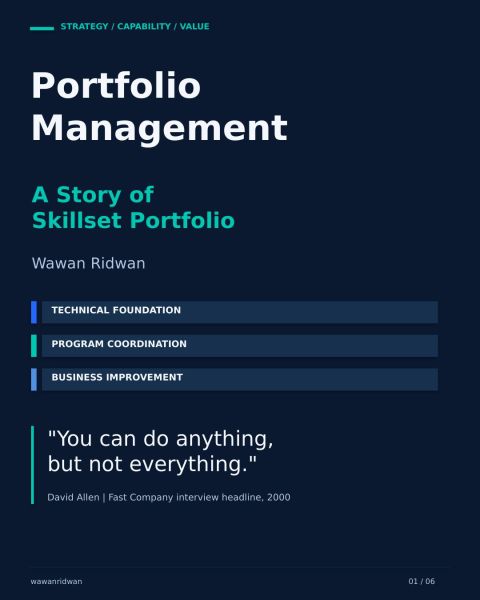
A person's career journey will accumulate a lot of skills. The question is not how many, but whether it is managed like portfolio management: there are choices, there are priorities, of course there are reviews.
"You can do anything, but not everything." David Allen (2000)
https://lnkd.in/g4wZMfaX
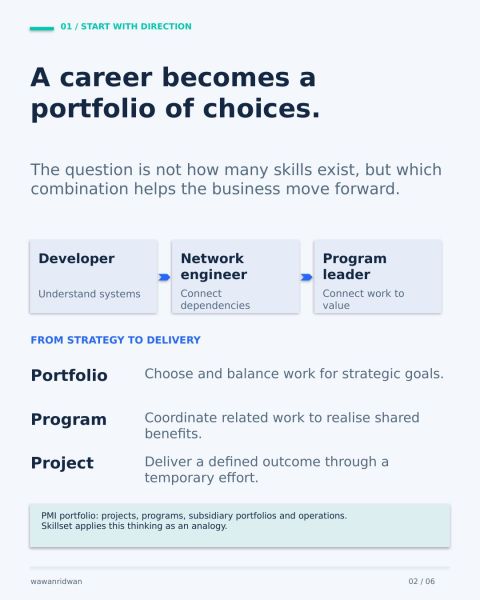
According to The 4th edition of The Standard for Portfolio Management, a
portfolio is a collection of projects, programs, subportfolios, and operations
that are managed together to achieve strategic goals.
The same principle
applies to skillsets: selected, prioritized, and periodically reviewed.
Program management coordinates interrelated capabilities, while project
management executes them into tangible results.
In more than 18 years, the journey from software developer, network engineer, to leading programs and PMOs across industries has become a real analogy.
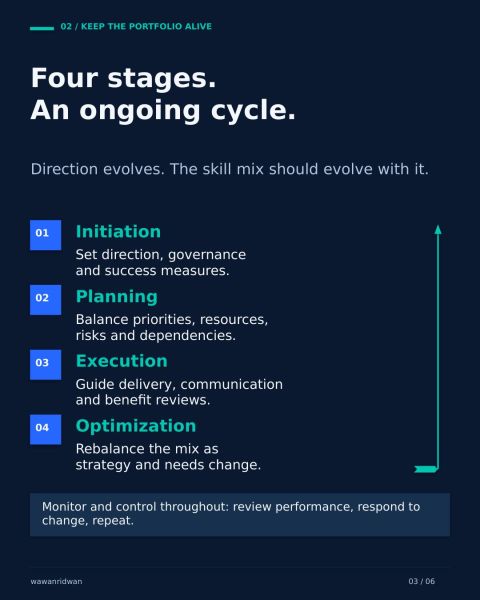
The stages follow a continuous life cycle:
1. Initiation: set the
direction, governance, and measure of success. The technical background helps
connect the solution with the business.
2. Planning: compiling priorities, resources, risks, and dependencies. Mapping many digital systems across industries trains the work sequence of the program.
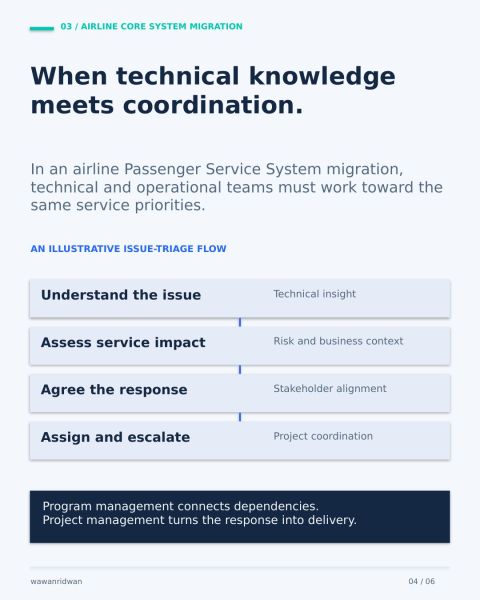
3. Execution: directing delivery, maintaining communication, and reviewing benefits. Airline core system migration brings together technical skills, project management, and stakeholder management.
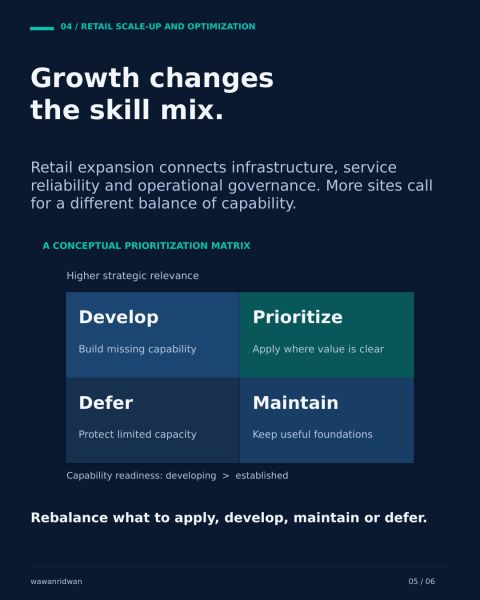
4. Optimization: rearrange the combination of components so that the benefits are in accordance with the strategy. Scale-up retail stores and their supporting systems show that skills must shift according to phases.
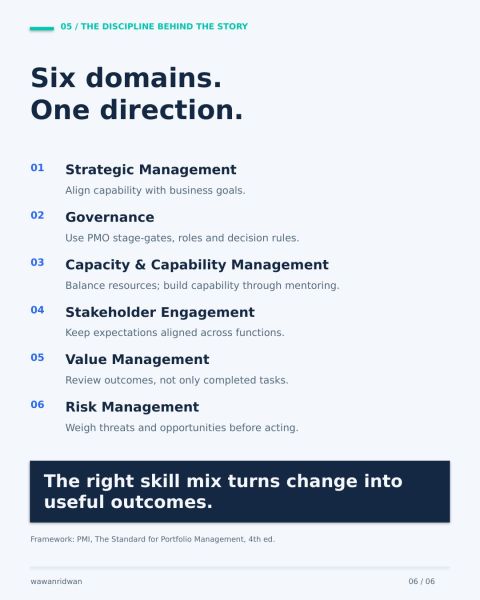
These four stages are supported by six performance domains:
1. Strategic
Management: maintaining alignment, such as digital transformation for
operational needs.
2. Governance: clarifying authority and decisions through PMO, stage-gate, RASCI, and KPI.
3. Capacity and Capability Management: balancing resources and abilities, one of which is through mentoring.
4. Stakeholder Engagement: aligning cross-functional expectations during system migration.
5. Value Management: measuring outcomes, not just getting work done.
6. Risk Management: weighing threats and opportunities before acting.
Monitoring and control run throughout the cycle: review performance, respond
to changes, and then repeat.
That way, the portfolio's skillset
remains relevant and continues to grow.
PMI, The Standard for Portfolio Management, 4th ed.:
https://lnkd.in/gQ6sPBnY
Semua link: https://lnk.bio/wawanridwan

No comments:
Post a Comment